
Sermons
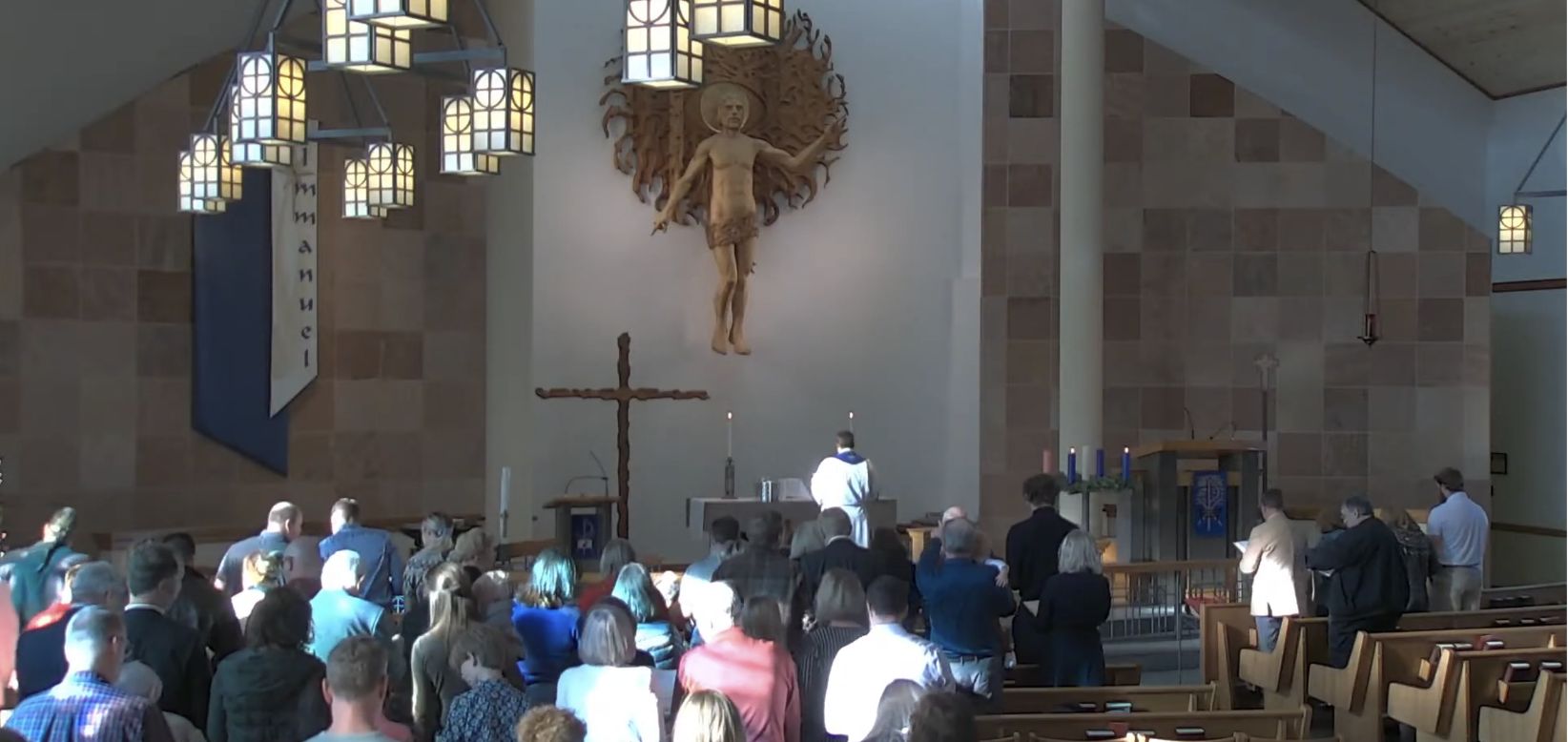
Watch our Sunday Service

- Speaker: Aaron Richert
- Sunday, October 4th, 2026
Nineteenth Sunday After Pentecost
Hide transcript 
Transcribed by TurboScribe. Go Unlimited
Grace, mercy, and peace to you from God, our Father, through our Lord and Savior Jesus Christ. Amen. And let us pray.
O Lord, send forth your word into our ears, that it may bear fruit in our lives. In Jesus' name, amen. So what do you like to watch on TV? What kind of movies do you watch? I don't think I would ever want to actually be a trial lawyer, but I do like the courtroom shows.
I'm looking forward to the final season of Lincoln Lawyer when it's finally released. I've seen a lot of the John Grisham movies, and who doesn't love my cousin Vinnie? But I like those scenes when someone gets cornered on the witness stand. I think, for example, of the movie A Few Good Men.
Even if you haven't seen the movie, you've probably seen some rendition of the exchange between Tom Cruise and Jack Nicholson, the one that ends with, you want answers, I want the truth, you can't handle the truth. Just the buildup to that moment, it's beautiful. It starts with Tom Cruise asking about life on base under Nicholson's leadership.
Through casual back and forth, he gets the colonel to testify that on his base, soldiers always follow orders. Out here, we follow orders or people die. And with that admission, the trap is set.
If your soldiers always follow your orders, and if you ordered your soldiers not to harm the one soldier, then why did you need to transfer him off the base to keep him safe? Wasn't your order enough? So the colonel is caught by his own words, and the exchange escalates into that iconic scene. It's called the rhetoric of entrapment. And it happens when a speaker, maybe a lawyer, but maybe someone else, when a speaker structures their argument in such a way that their opponent is forced into a position that either undermines their credibility, or in extreme cases, where they have to admit their own guilt.
Think of the classic exchange between King David and the prophet Nathan. David, hiding what he had done with Bathsheba and Uriah, gets a visit from the Lord's prophet who proceeds to tell David the story of two men. One was wealthy and had abundant flocks.
The other was poor and had only one ewe lamb, and that lamb was more like a family pet than simple livestock. And a traveler came to visit the rich man, and rather than slaughtering one of his own many sheep for the meal, he took the family pet and served that instead. And David burned with anger against the rich man and told Nathan that a man like that has to pay four times over for that ewe.
You probably already know Nathan's iconic reply, David, you are the man. Entrapped by his own words, David recognizes his sin and turns to the Lord in repentance. The Old Testament reading today, its rhetoric of entrapment.
Isaiah sings a love song to the vineyard of the Lord. The Lord planted the vineyard on fertile hillside. He tilled the soil and removed all the stones, planted it with the best vines, built a wall around it to keep the wild animals out, built a watchtower to protect it from thieves.
He did everything possible, everything necessary for the vineyard to produce an abundant harvest, but when he looked, it yielded only bad fruit. With the song, Isaiah sets in place the pieces, getting ready to spring the trap. So then he turns to the audience and he asks, well, what do you think? You judge between me and my vineyard.
Was there anything more I could have or should have done? Am I not justified in tearing this vineyard down and planting another? To which the people would have, of course, responded, yes. And in that, the trap is sprung. The rhetoric of entrapment.
The vineyard of the Lord Almighty is you, O Israel. The people of Judah are the vines he delighted in, but when he looked for justice, he saw only bloodshed. And when he looked for righteousness, he heard cries of distress.
Therefore, he will take away the hedge of protection from around his people, break down their wall, the vineyard will be trampled, it will become a barren wasteland. There will be no rain there, and the only thing that will grow will be briars and thistles. The song of judgment.
And if the story stopped there, it would be a depressing end indeed. But Isaiah's vineyard song is more than just a clever way to tell the people that the coming judgment is their own fault. As with Nathan and David, the rhetoric of entrapment is meant to drive people to repentance.
Consider Psalm 80, a psalm most likely written only a few short years after Isaiah first delivered this vineyard song. And it's a psalm definitely written with this picture in mind. In Psalm 80, the psalmist cries out to God to restore his people, but hear what he says.
Lord, you have brought a vine out of Egypt. You drove out the nations and you planted it, you cleared the ground for it, and it took deep root and it filled the land, so that why have you broken down its walls, so that all who pass along the way pluck at its fruit? The wild boar from the forest ravages it, and all that move on the field feed on it. Turn back, O God of hosts.
Look down from heaven and see. Have regard for your vine which you planted, and for the son whom you made strong for yourself. You see, the psalmist recognizes that God's judgment against his vine.
He recognizes that the Lord is the one who can save the vine. He calls upon the Lord to reestablish the vine, even going so far as to call the vine God's son. And in those words, we get a glimpse of what God was up to all along.
The vinedresser did everything he could for his vineyard, but it produced only sour grapes. The Lord did everything he could for Israel, delivered them out of Egypt, established them in the promised land, even dwelled among them in his temple, but it produced only rotten fruit. And why? Well, because no matter what the gardener might do to the soil or the watchtower, if the vine is bad, the fruit will be too.
And so if the gardener wants a harvest of good grapes, he needs to plant a new vine. That's what our Lord did. I am the true vine, says the Lord Jesus Christ, and my Father is the vinedresser.
I am the vine, said Jesus, and you are the branches. Whoever abides in me and I in him, he it is that bears much fruit. Apart from me, you can do nothing.
When our Lord looked out over his vineyard of old, he saw nothing but rotten fruit. What began as the choicest of vines had grown diseased and corrupted by sin, and no amount of wall fixing or soil tilling was going to fix that. The solution was to tear down the vineyard and plant a new one.
And so that's what our Lord did. He sent the true vine into the world to bear good fruit. We're in the same boat today.
We are sinful people. If our Lord were to address our sinful fruit by simply tilling the soil and building a better wall, by changing the circumstances around us, he would still find the same spoiled harvest. The solution is not better soil.
The solution is a new vine. We don't need a change on the outside. We need a change within.
And that's what our Lord gives. Create in me a clean heart, O God. Renew a right spirit within me.
Put to death that which is sinful in me and raise me to new life in you. That's the gift our Lord gives. He gives it first in baptism, where all who are baptized into Christ Jesus are baptized into his death, buried with him by baptism into death, in order that just as Jesus was raised from the dead, we too might walk in newness of life, a new life and a new vine.
And then because we're baptized, we receive our Lord's gift of repentance, where the old Adam in us is daily drowned and put to death along with all sins and evil desires, and a new man daily emerges and arises to live before God in righteousness and purity forever. If anyone is in Christ, he is a new creation. The old has passed away and the new has come.
Our life is hidden in Christ, the true vine. And whoever abides in him, well, that's the one who bears good fruit. As the branch cannot bear fruit by itself unless it abides in the vine, neither can we bear fruit unless we abide in Jesus, the true vine.
And we do abide in Jesus, for he abides in us. He lives in us, and so we live in him. And we bear the good fruit the vine dresser is looking for.
We bear the fruit of repentance, not thinking more highly of ourselves than we ought, but humbling ourselves before our Lord and before each other. We bear the fruit of compassion, bearing with one another in our weaknesses. We bear the fruit of fellowship, praying together, laughing together, weeping together, living together.
We bear the fruit of community, giving of our time and our resources to support the work of God in this place. Apart from Jesus, we can do nothing. On our own, we bear only rotten fruit, but we are not on our own.
We are branches connected to the true vine, and so we bear fruit in him. The image of a vine. It's a picture our Lord gives us to remind us who we are and who he is.
It's an image that reminds us that what we need is not an outward change of circumstances, but a change within, a change that our Lord gives. So may he continue to work such a change in us. Through the proclamation of his words, the gift of his sacraments, may he continue to work such a change in us that we might bear much fruit in him.
In Jesus' name. Amen.
Read transcript
- Speaker: Aaron Richert
- Sunday, September 27th, 2026
Eighteenth Sunday After Pentecost
Hide transcript
Transcribed by TurboScribe. Go Unlimited
Grace, mercy, and peace to you from God our Father, through our Lord and Savior Jesus Christ, Amen. And let us pray, O Lord, send forth your word into our ears, that it may bear fruit in our lives, in Jesus' name, Amen. Let's start today with a short game, a little bit of trivia.
See how many of these proverbs you are familiar with. A stitch in time saves nine. You've heard that one.
It's better to fix a small problem while it's a small problem than ignore it and have it turn into a big problem. A bird in the hand is worth two in the bush. It's better to hold on to that one sure thing than gambling it away, chasing an unguaranteed prize.
Don't count your chickens before your eggs hatch. You know that one. Don't make plans or assumptions based on success that hasn't happened yet.
Too many cooks spoil the broth and too many people try to run or lead the same project. The results are usually worse for it. And finally, the fathers have eaten sour grapes and the children's teeth are set on edge.
Maybe you're not as familiar with that one. It's the proverb quoted at the beginning of today's Old Testament reading from Ezekiel. And while it might not be a common saying today, it was apparently very popular at one time because it shows up here and in the prophet Jeremiah.
More significantly, it's a proverb, God says, that he has no time for. As I live, declares the Lord God, this proverb shall no more be used by you in Israel. But why not? What does it mean? Don’t think about the imagery.
The fathers have eaten sour grapes. When's the last time you ate something sour or bitter, actually spoiled? Took a drink of the orange juice that's been in the fridge just a little bit too long? What'd you do with your face? Crinkle your nose in disgust? Did you gag just a little bit? Have you ever had that feeling while you're watching someone else eat something spoiled? But was it as intense as when you've eaten that thing yourself? We all know the general principle. When I eat something spoiled, it's my stomach that gets upset, not someone else's.
I bear the consequences for my own choices. If I eat poorly, I get indigestion. If I don't drink enough water, I get the headache.
And if I eat sour grapes, it's my teeth that ought to be set on edge. That's the meaning of the proverb. The proverb that the Lord bans from the mouths of his people.
The fathers have eaten sour grapes, but it's the children whose teeth are set on edge. It's the children who have upset stomachs. It's the children who suffer the consequences of the parents.
That's what the Lord banishes from the mouths of his people. Now, if you're like me, at this point you're probably wondering, why? Aren't there times where that's exactly how life works? It's not hard to think of examples when children suffer the consequences for their parents' choices. So why would the Lord ban his people from saying so? Happens on a small scale.
If a student is late for school because mom or dad wasn't ready on time, the parent doesn't get a tardy, the kid does. Or on a much more significant scale, like when parents are imprisoned or addicted or die young and then their children have to carry the emotional weight, the emotional scars for circumstances that just aren't their fault. There are obviously times when children suffer due to the sins of their parents, so why would God ban this proverb from his people? Well, it's because of the way they were using it.
So they weren't just making a general observation about how sometimes life gives you lemons, but this was an accusation against God. This was a charge that God is not being fair. Remember the circumstances of Ezekiel.
Ezekiel was part of the first group of people captured from Jerusalem, taken into captivity in Babylon. These are people who are being judged by God for generations of failing to listen to the prophets. And so this proverb is an accusation that it's not fair for God to punish them for something they didn't do.
Why were they the ones who are in exile when they weren't the ones who broke the covenant? Why were their teeth set on edge? Why did they have the upset stomach when it was their parents who had eaten the rotten grapes? The problem wasn't recognizing that the circumstances of life are impacted by the people around us, especially those closest to us. The problem was a spirit of blame, victimhood. And so ultimately the prophet is not saying that God is going to put an end to the way humans exist together.
What he's putting an end to is the excuse making. He's giving us a different way to react to the circumstances of our lives. He's not saying the sins of the parents will no longer affect the lives of their children.
He's saying the children would no longer use that as an excuse for their own failures. So we heard in verse 30, I will judge you, O house of Israel, every one of you according to his ways. Or in verse 4, all souls are mine, declares the Lord, the soul of the father and the soul of the son.
And he says, the soul who sins shall die. Everyone is accountable for his own sin, says the Lord. Stop blaming the circumstances.
Stop blaming other people as if that somehow excuses you. So you're in captivity because of the sin of your parents. What of it? You're still responsible for what you do there.
You're suffering under the weight of a burden you did not choose. But to paraphrase the wizard Gandalf, that's not for us to decide. All we have to do is decide what to do with the time that's given to us.
No longer, says Ezekiel, no longer will you mope around and pout and complain about how life's not fair. But again, the question is, why? Why not? Is it just because God doesn't like complainers? Is God just sick of people whining? No, it's more than that. It's because whining and excuse-making, blame-casting, well, they get in the way of the real solution.
The real solution is not to say, God, it's not my fault. The solution is to heed the prophet's warning and to acknowledge that if God will indeed judge each of us according to our own ways, he's got more than enough evidence against me. The real solution is to give up any claim to victimhood and instead throw ourselves at the feet of God's mercy.
The solution isn't to make up excuses for my sin, pretend that it was justified, or that God somehow just let it slide. The solution is repentance. That's the culmination of God's message through Ezekiel.
The last verses of the chapter we read this morning, repent and turn from all your transgressions, lest iniquity be your ruin. God doesn't want his people to end up in ruin. Cast away from you all the transgressions you have committed.
Make yourselves a new heart and a new spirit. Why will you die, O house of Israel? I have no pleasure in the death of anyone, declares the Lord God. So turn and live.
God takes no pleasure in the death of anyone. So turn and live. Why will you die, O house of Israel? Why will you stubbornly refuse to repent? Turn and live.
Why do you keep excusing your sin, blaming it on circumstances that are out of your control? Don't you understand what you're doing? Why are you fighting to keep your sin? Why not just let it go? Turn and live. That's our Lord's invitation to us also. The world in which we live will give us a laundry list of excuses that justify our sinful behavior.
Some can point to the upbringing, maybe something in my subconscious, some claim of just being born that way. Don't blame me for what I said. I just have a bad temper.
Our Lord invites us to drop all the excuses and to remember who he actually is. He's the God who took on human flesh to forgive our sin. He's the one who became obedient unto the point of death, even death on a cross.
He's the God who has already forgiven our sin. So why do we hold on to it? Why would we make excuses? Why would we want to fight to keep our own sin from the one who wants to remove it from us, as far as the East is from the West? Let us rather be people who rejoice in our Lord's gift of forgiveness. Rather than complaining about sour grapes, we sip from the sweet wine of forgiveness.
We feast on the bread of reconciliation. We rejoice that our Lord has claimed us through our baptism, that he continues to forgive our sin through the ones he sends to stand in his stead. We rejoice in our Lord's church, for here we are not pressured to find excuses for ourselves.
We're under no obligation to justify our behavior or to wallow under the weight of perpetual victimhood. Here we rejoice in the one to whom every knee will bow, and we find our hope in the new life we already have in him. It's a life of forgiveness, a life of reconciliation with our Lord and with each other.
We rejoice to forgive each other, eager to maintain the unity we have been given as the body of Christ. So no, we don't let the circumstances of our lives drive us to a spirit of blame or bitterness or victimhood. Rather, we stand steadfast on our Lord's word of forgiveness.
The new life we have in him, letting go of our sin, receiving the gift of love from him until the day of Christ's return. In Jesus' name, Amen.
Read transcript
- Speaker: Aaron Richert
- Sunday, September 20th, 2026
Seventeenth Sunday After Pentecost
Hide transcript
Transcribed by TurboScribe. Go Unlimited
Grace, mercy, and peace to you from God our Father, through our Lord and Savior Jesus Christ. Amen. And let us pray.
Oh Lord, send forth your word into our ears that it may bear fruit in our lives. In Jesus' name. Amen.
Since I didn't study Romans this week, I studied something else and I learned a new word. Ultracrepidarian. Ultracrepidarian.
The word crepida refers to a specific type of Greek sandal, and so someone who is ultracrepidarian is a person who literally goes beyond the sandal. Aren't you glad you know that? You want to know what it means? The term has its root in the 4th century BC. According to legend, there was a famous Greek painter named Apellas, and he likes to publicly display his new paintings while he hid behind the canvas, listening to the feedback from people as they passed by.
So one day, a local sandal maker walked past, pointed out that Apellas had painted the sandal wrong, didn't have the right number of straps. Apellas, grateful for the critique, fixed the painting that night. The next day, the sandal maker returned and noticed the correction.
He's proud of himself. He was overconfident that the artist had taken his advice, and so he began loudly critiquing other parts of a painting, at which point Apellas, annoyed by the man's arrogance, popped out from behind the painting and scolded him, saying, a shoemaker should not judge beyond the sandal. Ultracrepidarian.
One who goes beyond the sandal. Giving advice or opinions on matters that are outside of one's knowledge base or competence. It's the restaurant patron who probably can't boil macaroni, criticizing the award-winning chef for the way the dish was prepared.
It's the guy who's never put on a pair of shoulder pads or helmet in his life, sitting on the couch pontificating on what the coach or quarterback for his favorite NFL team should have done. It's the actor or musician who's trained in vocal inflection and body movement, lecturing their audience on medical or political issues. It's ultracrepidarian, and if we're honest, we have to admit we're all guilty of it at one time or another.
But more importantly, if we're paying attention, we'll see it lingering in the background of the readings we heard just a few moments ago. My thoughts are not your thoughts. Neither are my ways your ways, declares the Lord, for as the heavens are higher than the earth, so are my ways higher than your ways and my thoughts than your thoughts.
With these words, our Lord reminds us that he is one of a kind. There is none who is like him, and any attempt on our behalf to correct him or advise him goes beyond the sandal of our own expertise. So my mind goes immediately to God's conversation with Job.
When the Lord answered Job out of the whirlwind and said, who is this that darkens counsel by words without knowledge? Dress for action like a man. I will question you, and you make it known to me. Where were you, Job, when I laid the foundations of the earth? Tell me if you're so smart.
Who determined its measurements? Surely you know. The Lord's words to Job are the biblical example par excellence of God calling someone ultracrepidarian. Stay in your lane, Job.
My ways are not your ways, so don't presume to tell me what to do. And to be sure, there's truth in that warning. We don't understand how the universe works, and so we shouldn't presume to tell God he's doing it wrong.
It would be foolish for me to walk into the chemist's lab surrounded by beakers and bottles of liquids and powders that I have no idea what they are, no idea what they do, and to suggest or maybe even demand that the chemist add this to that mixture, I might blow up the whole building. And so also it's ultracrepidarian, it's presumptuous of us to look to the creator of the universe, tell him what he ought to do differently. There's certainly godly wisdom in that warning.
But the thing is, in today's readings, our Lord addresses presumption with a different tone. These are not ultimately words of warning. They're more than a rebuke to stay in your lane.
They're an invitation to trust in his goodness and to stand firm in his promise to deliver. Take the gospel reading, the parable of the workers. Different people all received the same payment, even though they worked different amounts.
And when some complain at the end, the master looks at them and says, friend, I have done you no wrong. Now the Greek word that's used for friend there is a decidedly unfriendly word. It's sarcastic, maybe even a little sassy.
The master's words are better understood along the lines of, look buddy, listen here pal, I've done no wrong. Why do you begrudge my generosity? So there is definitely a tone of stay in your lane. But look at what the master's defending, his generosity.
Jesus tells this parable to defend our Lord's desire to forgive even the worst sinners without any regard for what they have earned or what they might be able to give him in return. He's defending his decision not to give up on us. And when Satan accuses you before our Lord, when Satan says you are not worthy of forgiveness, or when shame or embarrassment tempt you to tell the Lord yourself that he ought not give you his gifts, our Lord lovingly says to you, stay in your lane.
Don't step beyond your sandal. Mercy is mine to give, forgiveness mine to give, and I love to give it. So what if I don't give it according to the world's expectations? What does it matter if I don't give it only to those whom the world considers worthy? My ways are not like your ways, says the Lord.
My thoughts are not like your thoughts. The same dynamic is in Isaiah 55. Today's reading began at verse 6. The first five verses of the chapter invite all who are thirsty to come by wine and milk without price, to delight in the rich food the Lord gives, to be welcomed into God's eternal covenant with David.
And then in today's text, even the wicked is invited to forsake his ways. The unrighteous man is invited to forsake his thoughts. They are invited to return to the Lord while he may be found, in order that God may have compassion also on them, and abundantly to pardon them.
Now the way of the world is to keep outsiders outside. If the man is wicked, send him away. If the man is unrighteous, don't let him in.
If the person doesn't meet our expectation or match what we would consider worthy, the world says, let them find somewhere else to lay their head. But our Lord says, my thoughts are not your thoughts, and my ways are not your ways. For as high as the heavens are above the earth, so my ways are higher than yours, my thoughts higher than yours.
And so in the end, it's not really a message of mind your own business, pal. It's our Lord looking at us and saying, I know my grace doesn't make sense to you, but it doesn't have to. It's mine to give.
I give it to whom I choose, and I give it how I choose. And so maybe the gift of baptism doesn't make sense to us. How can water do such great things? Why baptize a baby who isn't even a month old? Wouldn't it make more sense to wait until the child grows up? Decide for herself whether or not she believes what the Bible says.
Whether or not she wants to be baptized. Whether or not she wants to become part of our Lord's church. But our Lord says, my thoughts are not your thoughts, my ways are not your ways.
Whether or not it makes sense to us is beside the point. This is a gift our Lord has given. The gift of new birth through water and the Word.
The gift of new life in Him. Adoption into His family. Because it's His gift, we have no reason to doubt it.
It doesn't need to make sense to us. We have confidence in it because we have confidence in Him. And so maybe the Lord's Supper doesn't make sense to us.
How can bread be body but still be bread? Or wine and blood? How can our Lord be present bodily in this meal if His body ascended into heaven? Seated at the right hand of the Father. Wouldn't it make more sense to say the bread and wine just represent the body and blood? That this is a meal we celebrate not because Jesus is present in it, but because we want to remind ourselves of who He is and who we are as His church. But our Lord says, my thoughts are not your thoughts, my ways are not your ways.
Whether or not this makes sense to us is beside the point. This is a gift our Lord has given. It is the gift by which Jesus gives us His own body and blood in the means of bread and wine for the forgiveness of our sins.
It is the body and blood given with the bread and wine. They don't stop being bread and wine. It's the body and blood given under the bread and wine.
Because we don't see the body in the blood, we only see the bread and the wine. But the body and blood of Jesus are given in this meal in, with, and under the bread and the wine for the forgiveness of our sins, the strengthening of our faith. And because it's His gift, we have no reason to doubt it.
It doesn't need to make sense to us. We have confidence in it because we have confidence in Him. Sinful flesh will always be tempted to dismiss the things it doesn't understand.
But that is ultra crepedarian. Demanding that God work only in ways I understand goes beyond my sandal. And ultimately, let us not forget, if God were to operate only to worldly standards of justice and fairness, we would all be lost.
For the ways of the world we deserve only punishment for our sin. But His ways are not like the world's ways. So the gift of faith receives our Lord's promises, trusting that His thoughts are holy and His ways are good.
For He is the God who, out of love for His fallen creation, came down from heaven as the sacrifice that puts things right. He is the God who, out of love for all people, sent the good news of reconciliation out into all the world. And He is the God who, out of love for His church, continues to pour undeserved mercy on us, to forgive our sins, to feed us from His altar, to walk with us through this life and into the life to come.
And so His thoughts are not our thoughts and His ways are not our ways, but they are our life and salvation. And thanks be to God for that. In Jesus' name, Amen.
Read transcript
- Speaker: Aaron Richert
- Sunday, September 13th, 2026
Sixteenth Sunday After Pentecost
Hide transcript
Transcribed by TurboScribe. Go Unlimited
Grace, mercy, and peace to you from God our Father, through our Lord and Savior Jesus Christ. Amen. And let us pray.
O Lord, send forth your word into our ears that it may bear fruit in our lives, in Jesus' name. Amen. Well, today is our last reading from Romans, at least for a while.
We started our journey through this letter way back in the first Sunday of June, if you remember back that far, over three months ago, before summer. It's a long time. And so as we finish up today, what we're going to do is actually just review the whole thing.
Look at what Paul has said to this point, and then look at what he says today, and at the conclusion of this letter. And so we remember that Paul began the epistle by proclaiming the righteousness of God. He made the point that the true law of God is not limited just to the law of Moses, for when the Gentiles, who didn't have the law of Moses, didn't have any of God's written word, when they still did by instinct, or because they thought it out, when they still did the things the law demands, they became a law unto themselves.
And so Paul says the holiness of God is written into his design for creation, and therefore all are accountable to it. All who sinned without the law of Moses, well, they perish without the law of Moses. And all who sinned under the law of Moses are judged by that law.
The same is true of any law we try to invent for ourselves today. When it comes to our status before the righteous God, there is no distinction between Jew and Gentile. We all have sinned.
We all have fallen short of the glory of God. And, as Paul says, we are all justified by his grace as a gift through the redemption that is in Christ Jesus. He used the story of Abraham to illustrate the point.
Abraham's circumcision did not save him, for God declared Abraham righteous years before he instituted circumcision. And neither did the law of Moses make Abraham righteous, because the events of Sinai didn't take place for centuries after Abraham died. No, Abraham was declared righteous by faith.
Abraham believed God, and God rewarded that trust. Abraham believed that God was able to do what he promised, and God considered Abraham right because of that faith. The same is true of us, Paul says.
It's Jesus. Not any works of any law. It's Jesus who is the source of our peace with God.
He is the last Adam through whom all mankind is reconciled to God and to each other. The first Adam's sin brought guilt, brought the desire for sin, brought death to all people. And so our Lord sent a new Adam to bring about a new humanity.
And that happens through baptism, when we are united to Christ and raised to walk in newness of life. But this new life we live, Paul says, it's a struggle. We're still bound to our sinful flesh, and so as God's holy law confronts our fallen nature, it still accuses us, even condemns us in our sin, even for Christians, revealing our sinfulness, revealing to us the unattainable standard of God's holiness.
But, Paul says, that doesn't drive us to despair. For the gift of faith remembers that in Christ we have died to the accusation of the law. And so Paul tells us to see ourselves differently.
See ourselves as dead to sin and alive to God in Christ Jesus. And because we are alive in Christ, we no longer present our bodies as instruments of sin. We present them as instruments of God's righteousness.
We don't carelessly speak the hurtful word. We don't need to mindlessly indulge the temptation. We don't need to throw in the towel and give up as if sin sits on the throne of our existence.
That's not who we are anymore. In baptism we have been made new, and so we see ourselves as new, dead to sin and alive in Christ. And yes, in this new life we continue to struggle with sin, and yet because our Lord's Spirit dwells in us, we fight back.
But we fight back knowing that neither our small victories over sin nor our colossal failures, or anything else in between, none of that changes who we are in Christ. The Holy Spirit gives us the eyes of faith to see ourselves as heirs. Privileged to call God Father, not because we earned it through holy living, but because he adopted us.
And so the Holy Spirit gives us hope in the midst of our suffering. Help in the midst of our weakness. Assurance that all things work together to fulfill God's eternal good for you.
It's the death and the resurrection and the ascension of Jesus that guarantees our victory over anything and everything that would try to separate us from his love. The battle belongs to him. After those words of comfort, Paul turned his attention to the unbelief of the Jews, his fellow Jews, people to whom God had given so much.
We remember that after that, Paul is anticipating the question that people might ask. Can we really trust God's promises if so many people who had previously lived under his promises fell away, rejected his Messiah, and didn't listen? Paul insists that it's not the word of God that failed, and God wasn't acting unfairly or unjustly. No, he says, God is like the father and the prodigal son.
He's waiting for all of his children to join his banquet. He desires to show mercy on all people. And Paul points to himself.
He says the fact that he was chosen by God's grace, he who so zealously persecuted and even murdered the followers of Jesus, he says that he is living proof that God has not written off entirely all who are born descendants of Abraham, but he has a warning for the Gentile believers in Rome. He said don't look down on the Jews who rejected their own Messiah. He warns them that if God was willing to cut off in unbelief even the Israelites who rejected the Messiah, what do you think he will do to the Gentiles if they do the same? There is no distinction.
Neither those who are born Jew nor those who are born Gentile, none of us have any reason to boast before God or before each other. Rather, we all humbly rejoice that our Lord has included us in his people. Finally, Paul urges us to live in the newness of life that we've been given in baptism.
To present our bodies as living sacrifices because it's the only logical life that we could live after our Lord has given us the gifts he's given. Paul tells us where the body of Christ, describes what life in that body looks like. That's ultimately what's going on in today's reading.
Chapter 14, chapter 15. An exhortation to prioritize, to make important, to value the unity that characterizes the body of Christ. We heard his exhortation a few moments ago.
Welcome the one who is weak in the faith, do not quarrel over opinions. Now, the Greek word here is a little stronger than what we tend to mean when we use the word opinion. It's fairly easy not to end a friendship over something that's merely opinion.
One person likes pineapple on their pizza, the other one thinks that's a crime against humanity. While they might tease each other for fun, they don't really fight about it. But see, that's not the word that Paul is using here.
He's not talking about a simple opinion. The word he uses refers to a conclusion reached after careful consideration. And he's applying it, don't forget, not to a simple difference of opinion, but to disagreements over whether Christians should still observe things like food laws and clothing laws required by Moses.
So for us, it might be better to think about it in terms of people's views on political or social issues. Things like immigration or healthcare. These aren't just matters of taste that are easily ignored, like the difference over which flavor of ice cream you like.
They're positions that people hold based on what they prioritize, and they're viewpoints that people hold with great passion. And, Paul says, the body of Christ ought not quarrel over them. We ought not end friendships or destroy the unity we have in the body of Christ, even over things like this.
In the verses that follow today's reading, Paul will say things like, let us not pass judgment on one another any longer but rather decide never to put a stumbling block or a hindrance in the way of your brother. Paul says to decide not to put a stumbling block before your brother. To make it a priority. And he also says, do not, for the sake of food, destroy the work of God. He even begins chapter 15 with the admonition that those who are strong have the obligation to bear with the failings of the weak, and not to please themselves.
Let each of us please his neighbor, Paul says, for his neighbor's good, to build up his neighbor. Paul ends Romans with strong admonition that we ought not destroy the work of God by the way that we talk about, or the way that we handle disagreement in our midst. And so he ends the letter with an exhortation that's as timely now as it ever was.
And it's a final exhortation based on the reality he's been proclaiming since chapter 1. Don't undo the work God is doing among you. Do not, by appealing to any works of any law, undo the gift of salvation that is yours by faith. And, do not, by appealing to the law of Moses, or by creating a law of your own, do not place a stumbling block before your brother or sister in Christ that would drive a wedge into the body of Christ.
Remember that there is no distinction between Jew and Gentile. All are sinners in need of salvation, and all are made new in Christ. That's his message for us too.
Who I am in Christ, I am as a gift. Who you are in Christ, you are as a gift. A gift of God's mercy when he adopted you into his family in your baptism.
There's no room for either one of us to boast, only to rejoice. And so that's what we do. Within this body of Christ, we rejoice in our brothers and sisters.
We don't look for ways to drive wedges, we look for ways to build each other up. And we walk together through this life, trusting our Lord's promises, together. That's the end of Paul's teaching in Romans.
If you read on, there's a few more verses about logistical and practical concerns, but that's what Paul ends with. You are new in Christ, united to each other, rejoice in that gift, and live in that gift. And so we'll end our study in Romans with Paul's blessing that he first spoke to the Romans.
Today it's our blessing, today it's his blessing to you. May the God of hope fill you with all joy and peace in believing, so that by the power of the Holy Spirit, you may abound in hope. In Jesus' name.
Amen.
Read transcript
- Speaker: Aaron Richert
- Sunday, September 6th, 2026
Fifteenth Sunday After Pentecost
Hide transcript
Transcribed by TurboScribe. Go Unlimited
Grace, mercy, and peace to you from God our Father, through our Lord and Savior Jesus Christ. Amen. And let us pray, O Lord, send forth your word into our ears that it may bear fruit in our lives in Jesus' name.
Amen. Today we take up Romans chapter 13. Last week, Paul ended chapter 12 with the exhortation that Christians should not avenge themselves, but leave justice in the hands of God.
So in today's reading, he goes into more detail, pointing out that leaving justice in the hands of God doesn't mean just sitting by waiting for lightning bolts from heaven. Sure, there will be a direct, cosmic judgment of all evil on the last day. And on that day, as John describes it in Revelation, the saints of God will be vindicated.
Vindicated for all the wrong and for all the injustice that they've suffered at the hands of sinful men. But our Lord's justice isn't relegated to only the last day. It's already at work against those who do evil.
That's what the government is for, says Paul. For there is no authority except from God, and any authority that exists has been instituted by God. So it's worth pausing here to make sure we understand what Paul is saying and what he's not.
What he is saying is that governments and rulers didn't just come into existence because people thought it would be useful, or because some power-hungry villain used his strength or his wealth to force other people into oppression. Governments exist, Paul says, because out of love for his creation, God instituted the office to restrain evil and to promote good. And so any authority that the government does have, that the ruler does have, does not belong to the government itself, but it's authority derived from God.
So we think of it like any other vocation. Take, for example, the vocation of pastor. When our Lord created his church, he instituted the office of pastor.
And he gave to that office authority over certain things, like the public forgiveness of sins. And so when a man like myself steps into that office, the authority of that office is given for me to use. That's why when we get to the point of absolution and the divine service, I only forgive sins in the stead and by the command of my Lord Jesus Christ.
It's God who's ultimately forgiving your sins, but through the institution of the church, he uses imperfect people like me to do it. And it's true, sometimes people who do not meet the biblical qualifications for the office of pastor still step into that office. It's true that sometimes even wicked people or deceitful people step into the office of pastor.
It's true that sometimes faithful pastors go astray and abuse the authority of their office. And it's true that sometimes well-meaning pastors, whether through ignorance or misunderstanding, teach things that are contrary to God's word. But the failure or the shortcoming or the deceitfulness of any individual pastor doesn't mean that God contradicted himself concerning that office.
It doesn't make the office itself corrupt. It doesn't make the church wicked. The fact that unqualified people step into the office doesn't mean God wants them there.
The simple reality is that God has given shape and design to that office, to all vocations. He's called people to live in these offices and these vocations according to their design. And any failure of people in those vocations is not the fault of God himself.
It doesn't mean that's his design for the office. That's how government works. The office and the vocation of ruler has been created by God, not as a terror to good conduct, but to bad.
And any ruler who steps into that office is God's servant, to carry out God's wrath on the evildoer. And any authority that the ruler possesses is a derived authority based on God himself, not the ruler. And the authority that is given to the office by God is given for specific purposes.
That doesn't mean that God's always happy with the way sinful people act as rulers of this or that nation. It certainly doesn't mean that God is pleased with wicked rulers who step into the office and exercise it in a manner contrary to his design. And such rulers will one day have to answer to God himself for the way they've abused his institution.
But the institution itself remains good. And so Paul tells us to live in subjection to the institution for the sake of the conscience. That Greek word subjection has the same root as our English word taxonomy.
Taxonomy is the study of putting living things in their proper place. And so taxonomy happens when a biologist looks at something and asks, Is this thing a plant or an animal? Is it a mammal or a reptile? Is it a fish or a bird? Because every plant and every animal has its place within the order. So also the estates of the church or the family or the government.
Every vocation has its place according to God's design. And so we can ask ourselves, Is this vocation of the church or of the family? What other vocations does this exercise authority over? Whose authority is it under? A teacher is in authority over the student but under the authority of the principal. That's taxonomy.
So Paul's exhortation is for Christians to voluntarily and faithfully live under the order of God's design. His design for the church, his design for the family, and his design for the government. Within that ordering, Paul says, You pay to each person what they are owed according to their vocation.
Taxes to whom taxes are owed. Revenue to whom revenue is owed. Respect to whom respect is owed.
Honor to whom honor is owed. So it's also helpful to remember that submission to the order doesn't always mean obedience. When a sinful ruler violates their office, commands the citizens to disobey God's word, Christians will not obey, but we will still submit to whatever comes as a consequence of that refusal.
That's what we see in the stories of Daniel, Shadrach, Meshach, and Abednego, the apostles themselves in the book of Acts. They all refused to obey their rulers. They were all willingly imprisoned for their defiance.
Of course, more could be said about Christians living under the authority of the government. We're going to leave it there for today and continue on with what Paul says in Romans 13. Because he turns his attention to the importance of sacrificial love among the people of God.
And that's the guiding principle for everything he's going to say over the final chapters of the letter. Owe no one anything, he says, except to love each other. For the one who loves another has fulfilled the law.
Love does no wrong to a neighbor. Love is the fulfilling of the law. And so immediately after giving examples about paying people what they are owed, taxes, revenue, and honor, Paul turns around and says to owe no one anything, except for love.
Now he's not saying that Christians shouldn't borrow each other's tools or get a mortgage. What he's saying is that a Christian never leaves a debt unpaid, with love being the only exception. And why would that be the only exception? Because love is a debt that can never be repaid.
It's not measured like dollars and cents. No, love defines and characterizes what it means to be a Christian at all. In Paul's words, love is the fulfilling of the law.
More literally, the one who loves has brought the law to its fulfillment. A few chapters ago, Paul said Jesus was the end of the law, meaning Jesus is the goal towards which the law is pushing people. And here he says love is the fulfilling of the law.
It's the way in which that law shows up in the lives of God's people. The way in which it shows up in our lives. We'll hear more about it in chapters 13 and 14.
But today we simply rejoice in the comfort that this gives us. Our life in the body of Christ is characterized by love. First, that our Lord loved us and continues to love us.
And second, that we in turn love each other. I heard one pastor describe it like breathing. We breathe in, we breathe out.
We can't do one without the other, and both are necessary for life to exist. So also the love of our Lord. Our Lord fills our lungs with his word of life, with the forgiveness of sins, with the gift of his spirit.
Every time we gather together in this room around his gifts, our Lord is filling our lungs with air, with his breath, with his spirit. But you can't hold your breath forever. You have to exhale.
And so we leave this room to breathe the love that filled us here. We exhale into our families, into our jobs, into all of our vocations, by living in the order of God's design that he's built into this creation. We breathe out the words of forgiveness and reconciliation and love that have been spoken to us.
We exhale by voluntarily living in the order of God's design for this creation. And just like breathing, after we have exhaled, we need to breathe in again, to take in more of our Lord's air, so we're filled once again with his life. We breathe in, we breathe out.
We're forgiven by our Lord, we forgive each other. We're loved by our Lord, we love each other. And such life, such love, that is the fulfilling of the law.
It's the shape that God gives to our life as his children. It's how we live in the gift of our Lord's design. And so today we are once again filled with the life-giving breath of our Lord.
We've heard his proclamation of forgiveness. We've sung of his love. We will feast from his table.
And when we leave this place, we will exhale that love into our homes, into our church, into the world around us. We'll gather again next week to breathe in once more, and then to breathe out. We breathe in, we breathe out, for such is the life we share as the body of Christ in this place.
In Jesus' name, Amen.
Read transcript